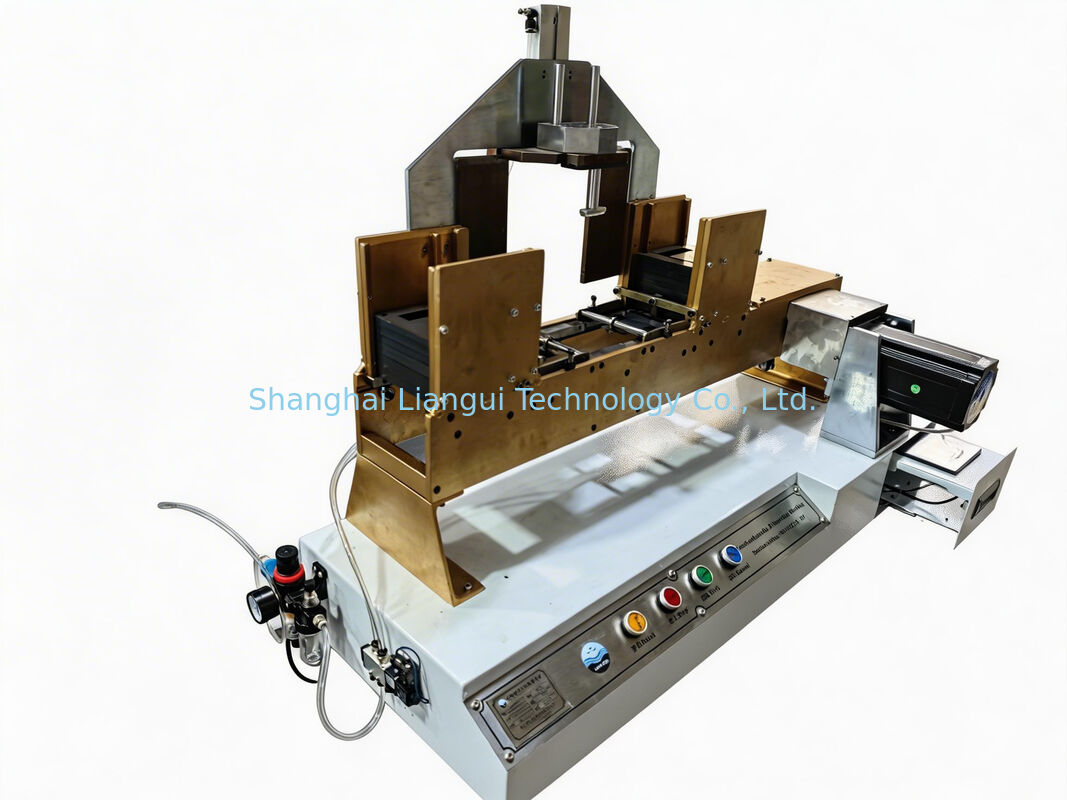
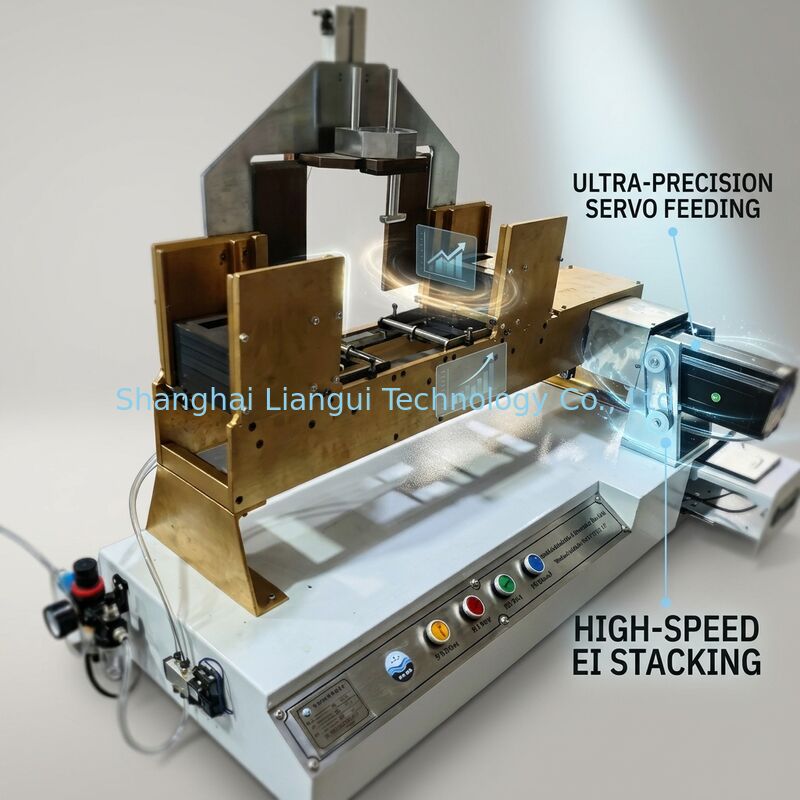
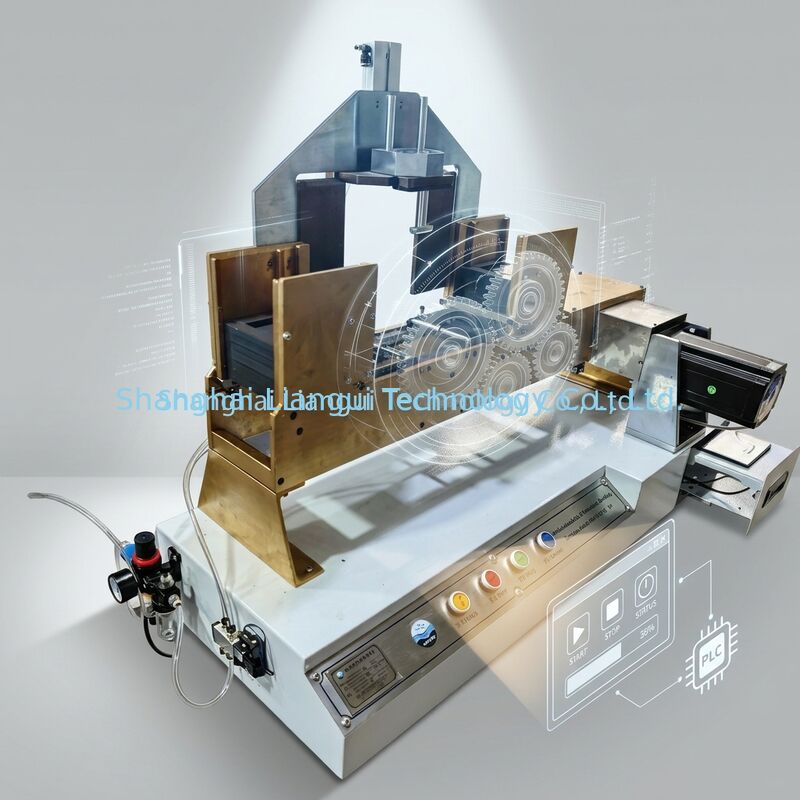
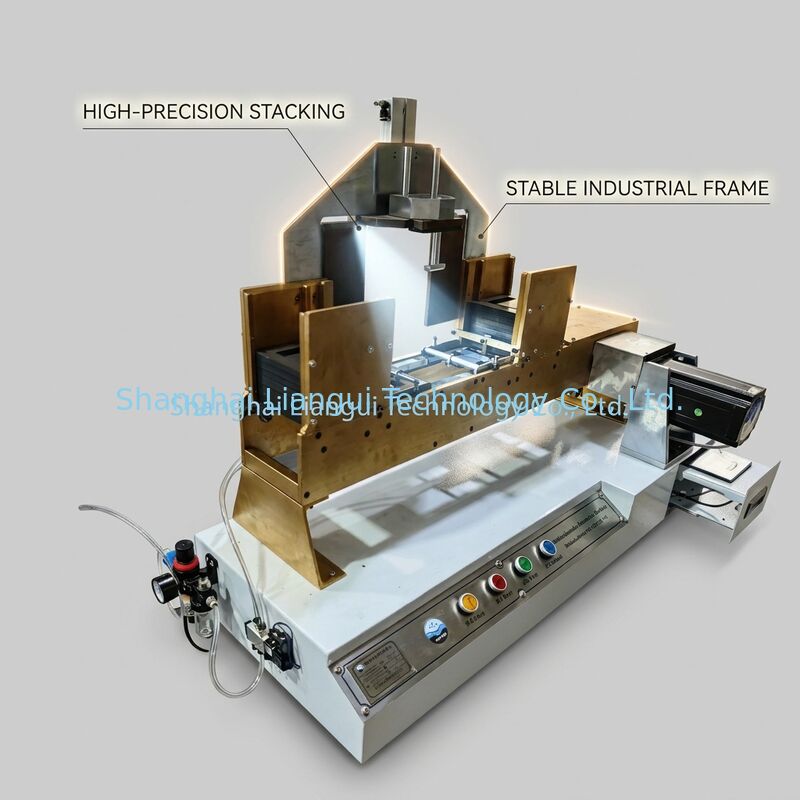
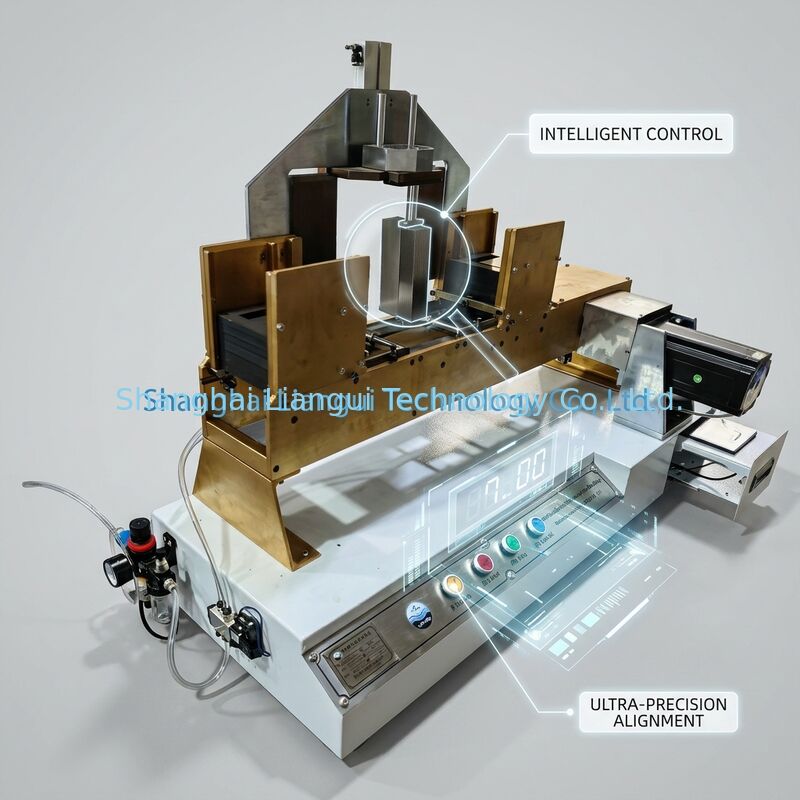
EI-120 Automatic Lamination Stacking Machine — 1000-2000 VA Industrial Power Transformer Cores
The EI-120 inserts E and I silicon steel laminations into transformer coil bobbins under PLC control, with servo-driven sheet feed, ±0.02 mm positioning accuracy and ±0.1 mm stacking accuracy at up to 250 stacks per minute. It is the frame we recommend for the 1000-2000 VA band of industrial power and control transformers, where one platform has to cover several core sizes without losing the stack on changeover.
| Model | EI-120 |
| Core range | 1000-2000 VA EI laminations |
| Stacking accuracy | ±0.1 mm |
| Positioning accuracy | ±0.02 mm (servo-driven feed) |
| Output | Up to 250 stacks per minute |
| Bobbin window | Approx. 36 mm |
| Control | Mitsubishi PLC with touch-screen HMI, one stored recipe per core size |
| Machine weight | 70 kg |
| Compliance | CE marked |
Read This Before You Specify a Stacking Machine
Most machine listings tell you what a machine can do. Fewer tell you when not to buy it. For a capital item that will sit on your floor for a decade, the second question matters more, so here is an honest selection guide for the EI-120 — including the two cases where we will point you at a different frame.
| Your situation | What we recommend | Why |
|---|
| Core programme concentrated at 10-100 VA | A smaller frame in the EI series | The EI-120 will run them, but a smaller model indexes faster on short stacks and costs less to own. Buying oversized capacity is a common and expensive mistake. |
| Core programme around 600-1200 VA, ~33 mm bobbin window | EI-105 | Same control platform, correct window for the band. Running a 1000 VA core through the EI-120 wastes cycle time. |
| Core programme in the 1000-2000 VA band, several core sizes, stack consistency already a complaint or a bottleneck | EI-120 | This is the profile the frame was sized for: one platform, stored recipes, ±0.1 mm held across the range. |
| Regularly above 2000 VA, or bobbin window well beyond 36 mm | EI-150 and above | Forcing a large core onto a mid-size frame costs you cycle time on every single piece. |
| Very low monthly volume, core count changes every week | Hand-crank stacking unit | Automatic stacking is not economical at that scale. We make manual units too, and will say so rather than sell you capacity you will not use. |
If your core sits on a boundary between two frames, send the stack drawing. The decision usually turns on the bobbin window and stack height, not on the VA figure alone.
What You Are Actually Buying
- A repeatable process, not a fast operator — ±0.1 mm stack accuracy and ±0.02 mm positioning hold the effective air gap where the design put it, shift after shift and after a tooling change.
- One platform across your range — a stored recipe per core size means changeover is a recall, not a re-setup. A mixed catalogue stops being a scheduling problem.
- Traceable output — the PLC counts every lamination and records the cycle, so a finished stack can be tied to the run that produced it.
- Protection for thin steel — gentle servo feed and controlled insertion preserve the insulation coating on 0.3 mm sheet, which is where eddy-current loss is decided.
- Jam detection as standard — the cycle stops on a misfeed before laminations are crushed or tooling is marked.
- CE-certified build — high-strength structural steel frame, dual grounding (220 V + 24 V), AC220V overload and DC24V short-circuit protection, emergency stop and safety guarding.
Inside the Stacking Cycle: What the PLC Actually Controls
Understanding the sequence is the fastest way to judge whether a stacker will fit your line. On the EI-120 the cycle runs in six controlled stages:
- Servo sheet feed — laminations are released from the magazine at a controlled rate; the servomotor sets feed position rather than a fixed mechanical stop, which is what makes a stored recipe possible at all.
- Presence confirmation — the sensor confirms the lamination before the stroke is allowed; a missing sheet is a fault, not a silent skip.
- E-lamination placement — the E lamination is positioned into the bobbin window to the stored depth, at ±0.02 mm repeatability.
- I-lamination insertion — the I lamination is driven home against the E stack; insert depth follows the recipe, not the operator's feel.
- Stack count verification — each completed stack is counted and compared with the recipe; a short or long stack raises a fault instead of passing quietly into the varnish line.
- Fault logging and recipe hold — misfeed, jam and short-stack events stop the cycle and are written to the controller with a timestamp; core size, count and depth stay loaded until deliberately changed.
Why the 36 mm window is the number to check first
On a 1000-2000 VA EI core, the bobbin window is the constraint that decides whether a mid-size frame can physically complete the stack. If your bobbin flange or wall thickness sits outside the approximately 36 mm window, no amount of parameter tuning will fix it — you need the next frame up. This is the single question that most often turns a "yes" into a "not this model", and it is worth resolving before price is discussed.
What a Buyer's Auditor Asks About Your Stacking Line
When an industrial power transformer buyer or a control panel builder qualifies a new source, the questions are rarely about price first. They ask how the core is assembled, how you know it is assembled correctly, and what happens when it is not. Those three answers decide whether a trial order becomes a framework agreement.
How is the core assembled? Laminations are fed, positioned and inserted by machine to ±0.1 mm stacking accuracy with ±0.02 mm positioning repeatability, from a stored recipe. The process does not depend on which operator is on shift.
How do you know it is correct? The PLC counts every lamination and records the cycle result. Stack count, insert depth and timing are held in a stored recipe per core size, so the specification on the drawing is the specification that was run.
What happens when it is not? Photoelectric and position sensing stop the cycle before laminations are crushed, the fault is written to the controller with a timestamp, and the affected piece is traceable to its batch.
Why 1000-2000 VA Cores Care About Stack Consistency
Below a few hundred VA, a loose stack shows up as a buzz you can hear. At 1000-2000 VA it shows up as heat. The effective air gap and the clamping pressure inside the core set the magnetising current, and a stack that is tight at the top and loose at the bottom changes the loss pattern along the limb. In a continuously rated industrial power transformer that becomes a hot spot inside a sealed unit — the one failure mode with no service access.
The second cost is the insulation coating. On 0.3 mm sheet the interlamination coating is the only thing standing between you and shorted laminations at the burr edges. A feed that grabs or a stroke that overshoots marks that coating, and the loss shows up in the no-load test weeks later, after the unit is wound and varnished. A controlled servo feed is a loss-control measure, not a speed feature.
Automatic Stacking vs Hand Stacking — What Changes on the Floor
| Production factor | Hand stacking | EI-120 automatic stacking |
|---|
| Output | Paced by operator fatigue and shift pattern | Up to 250 stacks per minute, continuous |
| Stack consistency | Varies by operator and by hour of the shift | ±0.1 mm every cycle, ±0.02 mm repeatability |
| Changeover between core sizes | Re-learned by the operator each time | Stored recipe recalled from the touch screen |
| Misfeed outcome | Often found after the stack is closed | Cycle stopped before the lamination is crushed |
| Insulation coating | Hand contact and burr drag mark the sheet | Servo-controlled feed and insertion, minimal contact |
| Traceability | Paper traveller, if kept at all | Cycle count and fault log held in the Mitsubishi PLC |
| Labour exposure | One operator committed to the station | Operator supervises the station and other work |
Key Specifications
| Parameter | Details |
|---|
| Model | EI-120 |
| Stacking Accuracy | ±0.1 mm |
| Positioning Accuracy | ±0.02 mm |
| Stacking Speed | Up to 250 stacks per minute |
| Applicable Core Range | 1000-2000 VA EI cores |
| Bobbin Window Width | Approx. 36 mm |
| Power Supply | AC 200~250V, 50/60 Hz (customizable; 380 V available on request) |
| Power Consumption | 30~60 W |
| Operating Environment | 0°C to 45°C |
| Service Air Pressure | 0.4-0.65 MPa (dry & clean air) |
| Silicon Steel Thickness | Compatible with 0.3 mm, 0.35 mm, 0.5 mm |
| Applicable Bobbin Type | Cardboard or plastic bobbin |
| Control System | Mitsubishi PLC with touch screen interface |
| Cycle Time | 1 to 60 seconds |
| Safety Features | Emergency stop, safety guards |
| Short Circuit Protection | AC220V overload protection + DC24V output short-circuit protection |
| Grounding | Dual grounding: 220V + 24V |
| Construction | High-strength structural steel frame |
| Machine Weight | 70 kg |
| Warranty | 12 months |
Typical Deployments
Large industrial power transformers, three-phase control units built around single-phase EI cores, industrial power supplies, welding power sources and heavy-duty isolation transformers in the 1000-2000 VA band. CRGO and CRNGO grades are both supported at 0.3 mm, 0.35 mm and 0.5 mm thickness, with cardboard or plastic bobbins. The machine runs standalone or inline with winding and varnishing.
| Application | What the stack decides |
|---|
| Industrial power transformer, 1000-2000 VA | No-load loss and temperature rise; a loose stack becomes a hot spot inside a sealed unit |
| Welding power source | Behaviour under repeated duty cycles and high inrush; stack integrity holds the regulation curve |
| Heavy-duty isolation transformer | Insulation integrity between laminations, decided at insertion, verified at no-load test |
| Three-phase control unit built on single-phase EI cores | Unit-to-unit consistency, so a panel builder stops re-tuning per batch |
Correct Frame for the Job — EI Series Ladder
| Core band | Frame | Note |
|---|
| 10-100 VA | Smaller EI frame | Faster indexing on short stacks; lower cost of ownership |
| 600-1200 VA | EI-105 | Approx. 33 mm bobbin window |
| 1000-2000 VA | EI-120 | Approx. 36 mm bobbin window |
| Above 2000 VA | EI-150 and above | For windows well beyond 36 mm and heavier stacks |
The full series runs from EI-19 to EI-300. [Confirm current frame list and window dimensions for the catalogue page — this table is the highest-value internal-link target on the site.]
Who Builds It, and What That Means for You
We are a direct manufacturer of EI lamination stacking equipment, CE certified, exporting to more than 20 countries and regions. Delivered equipment serves customers including GE Vernova and Eaton (USA), CATL and Chint Electric.
Practical consequences for a buyer: the frame, the servo feed and the control cabinet come from one supplier, so a recipe question is answered by the people who wrote the PLC program rather than by a trading intermediary; spare parts are sourced from the original build; and a non-standard voltage or bobbin does not require a new supply chain.
What You Receive With the Machine
- EI-120 stacking machine, assembled and cycle-tested before packing
- Mitsubishi PLC controller with touch-screen HMI and the core recipes agreed at order
- Servo feed and photoelectric misfeed sensing set, installed and calibrated
- Operation and maintenance manual, English [confirm additional languages]
- CE declaration of conformity and electrical schematic
- Recommended spare-parts list with part numbers for local sourcing
- Export packing: plywood case, braced for LCL or FCL [confirm packing spec]
Ordering, Delivery and After-Sales
- Lead time: 1-15 working days for standard configurations.
- Minimum order quantity: 1 unit — one machine is enough to run a trial programme.
- Payment terms: T/T. [Confirm deposit / balance ratio.]
- Indicative price: US$3,000 per unit. Final quotation follows drawing review; voltage, bobbin type and recipe count are the variables that move it.
- Warranty: 12 months.
- After-sales: professional technical support from the manufacturing team. [Confirm response time and whether spare parts are held for 5 or 10 years.]
- Installation: bench-top unit, 220 V single-phase supply (380 V on request) and 0.4-0.65 MPa dry air. [Confirm whether remote or on-site commissioning support is included.]
Frequently Asked Questions
Will the EI-120 handle a 1200 VA core as well as a 2000 VA core?
It will run both, but a 1200 VA core sits in EI-105 territory where a smaller frame indexes faster and costs less to own. If most of your volume is below 1000 VA, ask us for the honest comparison rather than defaulting to the bigger frame.
What is the largest core it can physically complete?
The limit is the bobbin window — approximately 36 mm — combined with stack height. VA rating is a useful shorthand, but send the drawing and we will confirm against the actual window rather than the nominal band.
Can it run on 380 V three-phase?
Standard supply is AC 200-250 V, 50/60 Hz. The supply is customizable and a 380 V build is available on request — tell us your plant voltage at quotation stage and the machine is built to it.
Which lamination thicknesses and grades are supported?
0.3 mm, 0.35 mm and 0.5 mm silicon steel, in both CRGO and CRNGO grades. Each thickness gets its own recipe, because insert depth and stack springback change with sheet thickness.
Does it accept both cardboard and plastic bobbins?
Yes, within the approximately 36 mm window. If your bobbin has an unusual flange or wall thickness, send the drawing and we will confirm the fit before you order.
Can one machine cover several core sizes?
Yes. Each core size is stored as its own recipe and recalled from the touch screen, so changeover is a selection rather than a mechanical reset. This is the main reason buyers consolidate several sizes onto one frame.
What happens if a lamination misfeeds?
The sensors stop the cycle before the insert stroke, so the lamination is not crushed and the bobbin is not scrapped. The fault is logged with a timestamp and the affected piece is traceable to its batch.
What do you need from me to quote accurately?
A core stack drawing or the lamination drawing, the VA rating and core size, bobbin type and material, your plant supply voltage, and the number of core sizes you intend to run. With those we confirm the frame and the recipe set, and quote against your actual cores rather than a catalogue range.
How to Get a Quotation Matched to Your Core
Send your core drawing and we will come back with a frame recommendation and a matched quotation — including the case where the answer is a different model.
- You send the stack or lamination drawing, VA rating, bobbin type and plant voltage.
- We check the core against the 36 mm window and confirm the frame size.
- You receive a quotation with the recipe set, packing and lead time (1-15 working days for standard configurations) in writing.
- On order, the machine is cycle-tested with your core specification before it is packed.
What to include in your first message: (1) core/lamination drawing, (2) VA rating, (3) bobbin type and material, (4) supply voltage and frequency, (5) monthly or annual volume, (6) destination port.
Model EI-120 — Quick Reference
Automatic EI lamination stacking machine for 1000-2000 VA transformer cores. ±0.1 mm stacking accuracy, ±0.02 mm positioning, servo-driven feed, up to 250 stacks per minute, Mitsubishi PLC with a stored recipe per core size, 0.3/0.35/0.5 mm CRGO and CRNGO laminations, cardboard or plastic bobbins, approx. 36 mm bobbin window, AC 200-250 V, 70 kg, 12-month warranty, CE marked, MOQ 1 unit, 1-15 working days lead time.


 Your message must be between 20-3,000 characters!
 english
 français
 Deutsch
 Italiano
 Русский
 Español
 português
 Nederlandse
 ελληνικά
 日本語
 한국
 العربية
 हिन्दी
 Türkçe
 indonesia
 tiếng Việt
 ไทย
 বাংলা
 فارسی
 polski