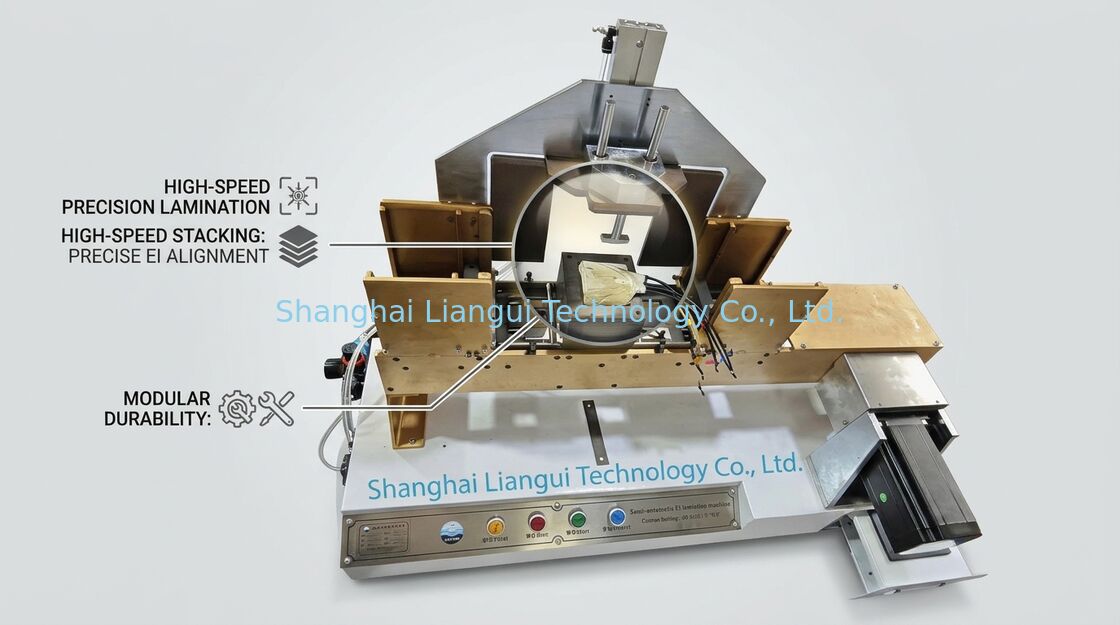
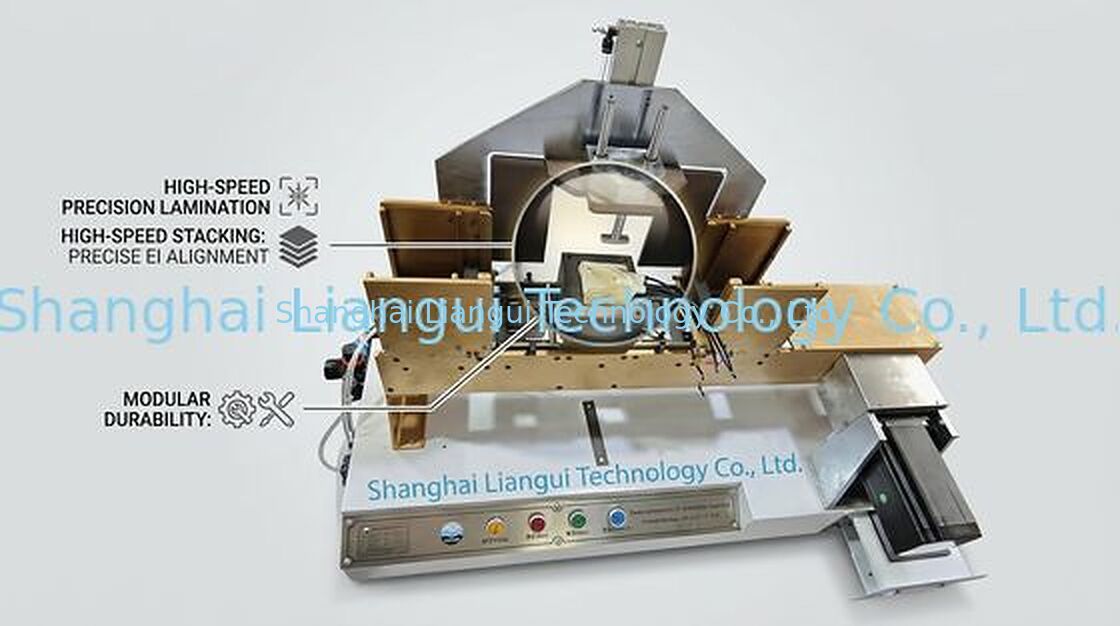
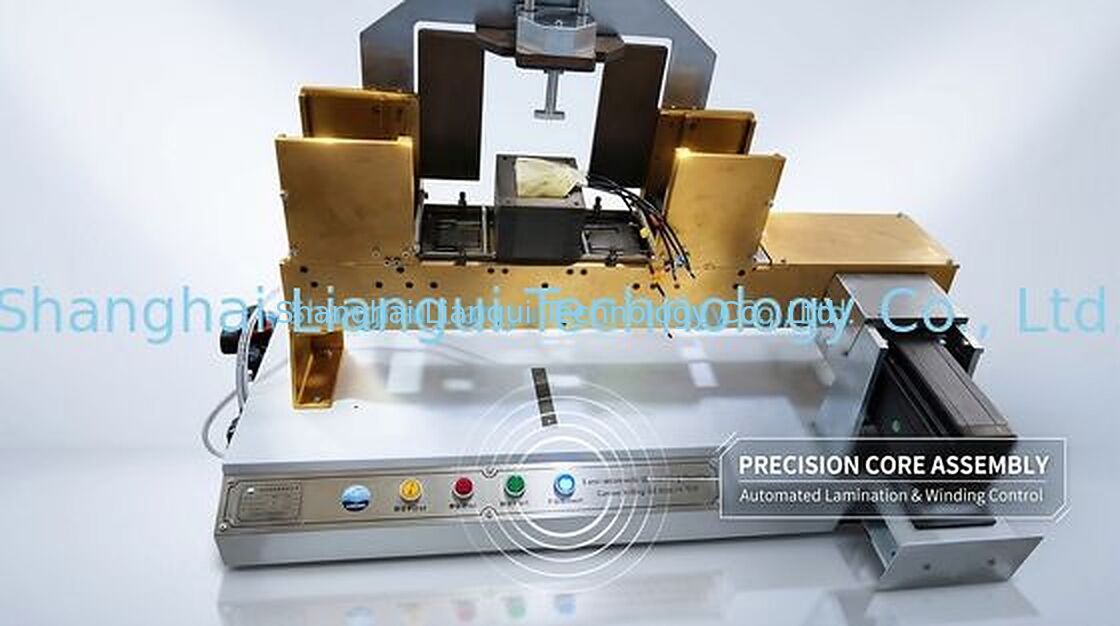
EI-105 Automatic Lamination Stacking Machine — 600-1200 VA Transformer Core Assembly
The EI-105 inserts E and I silicon steel laminations into cardboard or plastic bobbins under PLC control. It is built for one job: producing 600-1200 VA EI transformer cores to the same stack every shift, at up to 250 stacks per minute, with ±0.1 mm stacking accuracy and ±0.02 mm positioning repeatability. Footprint: 70 kg, bench-top, single-phase supply.
| Model | EI-105 |
| Core range | 600-1200 VA EI laminations |
| Stacking accuracy | ±0.1 mm |
| Positioning repeatability | ±0.02 mm |
| Output | Up to 250 stacks per minute |
| Control | PLC with touch-screen HMI, one stored recipe per core size |
| Machine weight | 70 kg |
| Compliance | CE marked |
What Actually Stops a Stacking Line — and How the EI-105 Handles It
Buyers rarely lose money on the purchase price of a stacker. They lose it on the three failures that show up after commissioning: laminations crushed by a misfeed, stack depth drifting between shifts, and a core that cannot be traced back to its run when a customer complains. Each of those is an operator instruction in most shops. On the EI-105 it is a mechanical or control-level answer.
Misfeed before crush
Photoelectric sensors watch the lamination path. When a lamination does not arrive in position, the cycle stops before the insert stroke, the fault is written to the controller, and the affected piece is quarantined rather than buried inside a finished core. A stopped cycle costs minutes; a crushed lamination costs the whole stack plus the bobbin.
Depth that does not depend on who is on shift
Stack count, insert depth and cycle timing are held in a stored recipe per core size. The operator selects the recipe; the PLC runs it. The drawing tolerance you approved is the tolerance that runs on night shift, on a new hire's first week, and after a tooling change.
Traceability that satisfies an audit
Every cycle result is counted and logged by the PLC. When a machine tool builder or a data-centre equipment supplier audits your process, the question is not "do you have a stacking machine" — it is "show me that core 4,000 was stacked to the same setting as core 4,001". The recipe log answers that without a paper traveller.
What a Buyer's Auditor Asks About Your Stacking Line
When a machine tool builder or a data centre equipment supplier qualifies a new transformer source, the questions are rarely about price first. They ask how the core is assembled, how you know it is assembled correctly, and what happens when it is not. Those three questions decide whether a trial order becomes a framework agreement.
How is the core assembled? Laminations are fed, positioned and inserted by machine to ±0.1 mm stacking accuracy, with ±0.02 mm positioning repeatability. The process does not depend on which operator is on shift.
How do you know it is correct? The PLC counts every lamination and records the cycle result. Stack count, insert depth and timing are held in a stored recipe per core size, so the specification on the drawing is the specification that was run.
What happens when it is not? Photoelectric sensors detect a misfeed and stop the cycle before laminations are crushed, the fault is written to the controller, and the affected piece is traceable to its batch.
Inside the Stacking Cycle: What the PLC Actually Controls
Understanding the sequence is the fastest way to judge whether a stacker will fit your line. On the EI-105 the cycle runs in six controlled stages:
- Feed and separation — E and I laminations are released from the magazine one at a time; the sensor confirms presence before the stroke is allowed.
- E-lamination placement — the E lamination is positioned into the bobbin window to the stored depth, with ±0.02 mm repeatability.
- I-lamination insertion — the I lamination is driven home against the E stack; insert depth follows the recipe, not the operator's feel.
- Stack count verification — each completed stack is counted and compared with the recipe; a short or long stack raises a fault instead of passing quietly.
- Fault handling and logging — misfeed, jam and short-stack events stop the cycle and are written to the controller with a timestamp.
- Recipe hold — core size, stack count and depth stay loaded until changed deliberately, which is what keeps two shifts producing the same part.
Material behaviour matters as much as the mechanism
The EI-105 is specified for CRGO and CRNGO silicon steel at 0.3 mm, 0.35 mm and 0.5 mm. Thickness changes the insert depth and the springback of the stack, which is why depth lives in the recipe instead of in a fixed mechanical stop. Running a new material without adjusting the recipe is the most common cause of a core that measures right at the top and loose at the bottom.
The 33 mm bobbin window is the real application limit
A bobbin window of about 33 mm puts the EI-105 in the 600-1200 VA band. That covers machine tool and CNC control transformers, UPS and inverter isolation transformers, industrial power supplies, and single-phase control units in three-phase equipment. If your core sits outside that window, tell us the stack drawing — the answer may be a different model rather than a compromise on this one.
Why These Two Applications Care
A machine tool control transformer sits behind the CNC drive, the servo amplifier and the safety circuit. Its output must stay stable through spindle starts and axis accelerations, because a control supply that sags under load turns into nuisance alarms that the machine builder's service team pays for. Stack consistency keeps the effective air gap and the regulation curve where the design put them.
A UPS transformer carries the more brutal job: it is sized for overload and inrush, and it is expected to work after years of sitting on float charge, waiting for a mains failure that may come once. Core loss and stack integrity decided at assembly are what remain when that day arrives — there is no second chance to fix a buzz or a hot spot inside a live installation.
Automatic Stacking vs Hand Stacking — What Changes on the Floor
| Production factor | Hand stacking | EI-105 automatic stacking |
|---|
| Output | Paced by operator fatigue and shift pattern | Up to 250 stacks per minute, continuous |
| Stack consistency | Varies by operator and by hour of the shift | ±0.1 mm every cycle, ±0.02 mm repeatability |
| Changeover between core sizes | Re-learned by the operator each time | Stored recipe recalled from the touch screen |
| Misfeed outcome | Often found after the stack is closed | Cycle stopped before the lamination is crushed |
| Traceability | Paper traveller, if kept at all | Cycle count and fault log held in the controller |
| Labour exposure | One operator committed to the station | Operator supervises the station and other work |
Key Specifications
| Parameter | Details |
|---|
| Model | EI-105 |
| Stacking Accuracy | ±0.1 mm |
| Positioning Accuracy | ±0.02 mm |
| Stacking Speed | Up to 250 stacks per minute |
| Applicable Core Range | 600-1200 VA EI cores |
| Bobbin Window Width | Approx. 33 mm |
| Power Supply | AC 200~250V, 50/60 Hz (customizable) |
| Power Consumption | 30~60 W |
| Operating Environment | 0°C to 45°C |
| Service Air Pressure | 0.4-0.65 MPa (dry & clean air) |
| Silicon Steel Thickness | Compatible with 0.3 mm, 0.35 mm, 0.5 mm |
| Applicable Bobbin Type | Cardboard or plastic bobbin |
| Control System | PLC with touch screen interface |
| Short Circuit Protection | AC220V overload protection + DC24V output short-circuit protection |
| Grounding | Dual grounding: 220V + 24V |
| Machine Weight | 70 kg |
| Warranty | 12 months |
Core Programs the EI-105 Covers
A bobbin window of about 33 mm puts the EI-105 in the 600-1200 VA band: machine tool and CNC control transformers, UPS and inverter isolation transformers, industrial power supplies, and general three-phase related single-phase control units. CRGO and CRNGO grades are both supported, at 0.3 mm, 0.35 mm and 0.5 mm sheet thickness, with cardboard or plastic bobbins. The machine runs standalone or as a station in a winding-to-varnish line, and each core size keeps its own saved recipe. [Confirm with us: full list of core sizes already commissioned on this model.]
What You Receive With the Machine
- EI-105 stacking machine, assembled and cycle-tested before packing
- PLC controller with touch-screen HMI and the core recipes agreed at order
- Photoelectric misfeed sensing set, installed and calibrated
- Operation and maintenance manual, English [confirm additional languages]
- CE declaration of conformity and electrical schematic
- Recommended spare-parts list with part numbers for local sourcing
- Export packing: plywood case, air-dried and braced for LCL or FCL [confirm packing spec]
Ordering, Delivery and After-Sales
- Minimum order quantity: 1 unit — one machine is enough to run a trial programme.
- Payment terms: T/T. [Confirm deposit / balance ratio.]
- Indicative price: US$3,000 per unit. Final quotation follows drawing review; voltage, bobbin type and recipe count are the variables that move it.
- Lead time: [To be confirmed — state standard lead time and expedited option.]
- Warranty: 12 months.
- Spare parts and support: [Confirm spare-parts holding period and response time.]
- Installation: bench-top unit, single-phase supply and 0.4-0.65 MPa dry air. [Confirm whether remote or on-site commissioning support is included.]
Frequently Asked Questions
Can the EI-105 run on 380 V three-phase?
Standard supply is AC 200-250 V, 50/60 Hz. The supply is customizable, so tell us your plant voltage at quotation stage and the machine is built to it.
Which lamination thicknesses are supported?
0.3 mm, 0.35 mm and 0.5 mm silicon steel, in both CRGO and CRNGO grades. Each thickness gets its own recipe, because insert depth and stack springback change with sheet thickness.
Does it handle both cardboard and plastic bobbins?
Yes. Both bobbin types are supported within the approximately 33 mm window. If your bobbin has an unusual flange or wall thickness, send the drawing and we will confirm the fit before you order.
What is the minimum order quantity?
One unit. A single machine is enough to run a trial programme or to serve a dedicated core size on an existing winding line.
Can one machine cover several core sizes?
Yes within the 600-1200 VA band. Each core size is stored as its own recipe and recalled from the touch screen, so changeover is a selection rather than a mechanical reset.
How is the machine powered and connected on site?
Single-phase AC 200-250 V, 30-60 W, plus clean dry air at 0.4-0.65 MPa. Dual grounding (220 V and 24 V) and short-circuit protection on both the AC and the DC24V output are built in.
What happens if a lamination misfeeds?
The photoelectric sensors stop the cycle before the insert stroke, so the lamination is not crushed and the bobbin is not scrapped. The fault is logged with a timestamp and the affected piece is traceable to its batch.
What do you need from me to quote accurately?
A core stack drawing or the lamination drawing, the VA rating and core size, bobbin type and material, your plant supply voltage, and the number of core sizes you intend to run. With those we can confirm the recipe set and quote the same day.
How to Get a Quotation Matched to Your Core
Send your core drawing and we will come back with a matched configuration, not a generic price list.
- You send the stack or lamination drawing, VA rating, bobbin type and plant voltage.
- We confirm the EI-105 fits your core window — or tell you straight that it does not.
- You receive a quotation with the recipe set, packing, and lead time stated in writing.
- On order, the machine is cycle-tested with your core specification before it is packed.
What to include in your first message: (1) core/lamination drawing, (2) VA rating, (3) bobbin type and material, (4) supply voltage and frequency, (5) annual or monthly volume, (6) destination port.
Model EI-105 — Quick Reference
Automatic EI lamination stacking machine for 600-1200 VA transformer cores. ±0.1 mm stacking accuracy, ±0.02 mm positioning repeatability, up to 250 stacks per minute, PLC with stored recipes per core size, 0.3/0.35/0.5 mm CRGO and CRNGO laminations, cardboard or plastic bobbins, AC 200-250 V, 70 kg, 12-month warranty, CE marked, MOQ 1 unit.


 Your message must be between 20-3,000 characters!
 english
 français
 Deutsch
 Italiano
 Русский
 Español
 português
 Nederlandse
 ελληνικά
 日本語
 한국
 العربية
 हिन्दी
 Türkçe
 indonesia
 tiếng Việt
 ไทย
 বাংলা
 فارسی
 polski